Cracking in Ceramic Diesel Particulate Filters
Evident Industrial Resources These complex ceramic structures can potentially crack during manufacturing, handling, or in service, causing reduced performance or failure that can cause both environmental and engine damage. Ultrasonic testing can quickly and nondestructively detect internal cracking
Evident Industrial Resources
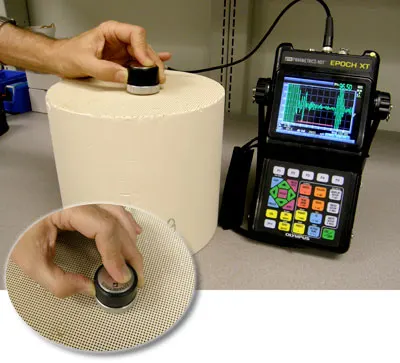
These complex ceramic structures can potentially crack during manufacturing, handling, or in service, causing reduced performance or failure that can cause both environmental and engine damage. Ultrasonic testing can quickly and nondestructively detect internal cracking in both new and used ceramic filter elements. The technique usually requires access to only one end of the cylinder.
Equipment
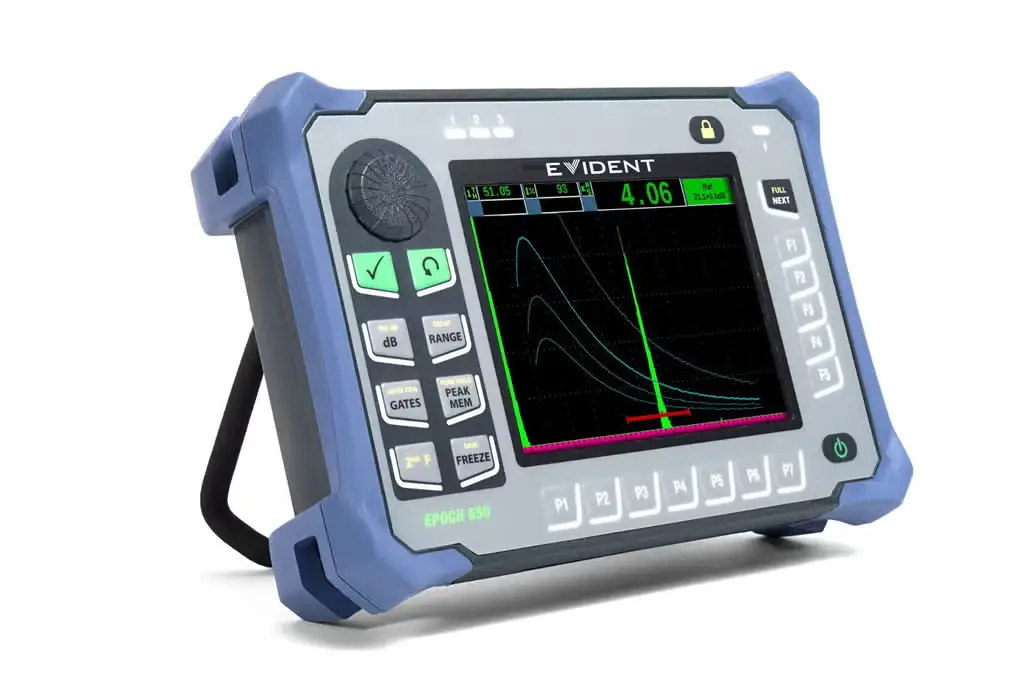
This test can be performed with both conventional flaw detectors and phased array instruments Any of the Epoch-series flaw detectors (EPOCH LTC, , EPOCH 650 or ) can be used with a low frequency contact transducer such as an A601S-RB or V601-RB (500 KHz). The OmniScan SX can also be used with the aforementioned transducers. A soft polymer membrane on the face of the transducer is used to couple sound energy into the filter without the need for liquid couplants that could be difficult to remove. The Advanced Filter option (standard on the ) can be helpful for improving signal-to-noise when testing larger filters by improving the instrument's low frequency response. Phased array testing can be performed with the OmniScan or and 1.5 MHz probes such as the 1.5L16-A4.
Procedure
Using firm hand pressure, the transducer is coupled to the end of the filter. High frequency sound energy propagating as plate waves travels through the ceramic honeycomb, reflecting off the far end if there are no discontinuities. If there is a crack parallel to the end surface, an echo will be received ahead of the point on the display representing the far end of the filter. If there is a crack that is tilted with respect to the ends, there may be no direct reflection but the echo from the far end will disappear.
In the example below representing a setup with a flaw detector and an A601S-SB transducer, the left screen image represents a typical echo pattern from an undamaged filter. The peaks at the left side of that waveform represent reverberations of the outgoing sound pulse, and the echo at the right side represents the reflection from the far end. There should be no significant echoes in the zone in the middle that is marked by the red gate. The right screen image represents an echo pattern from a filter that is cracked just past its midpoint. The backwall echo to the right of the gate has disappeared because sound energy is no longer reflecting from the far wall. The transducer can be moved to as many points as desired on the face of the filter to check for cracks at other locations.
Typical Backwall Echo from Good Filter
Typical Midwall Echoes from Cracked Filter
The specific instrument setup for each type of filter should be established through the use of a known good setup standard that is used to optimize the echo from the far end. By identifying the echo pattern from a good filter and looking for changes, a trained operator can quickly and reliably identify echo variations that correspond to internal cracks.
Phased Array Testing
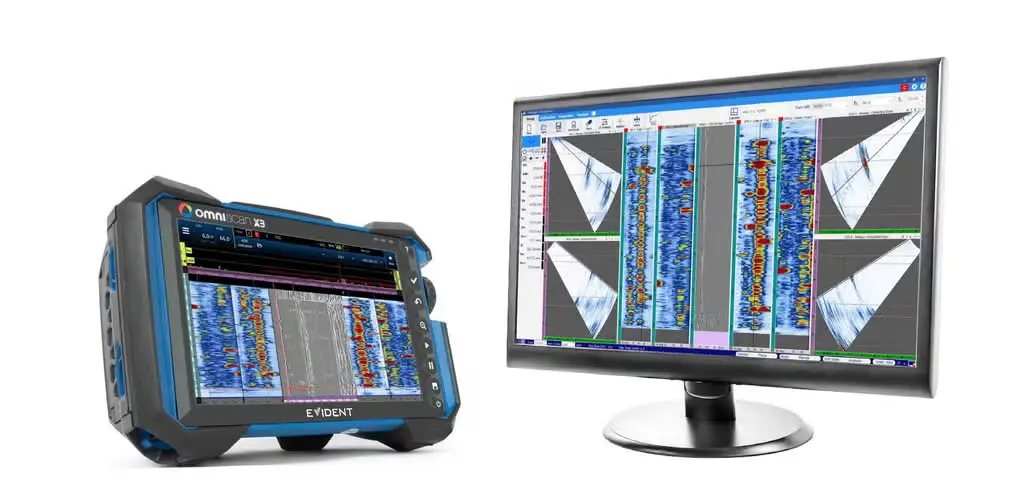
OmniScan X3 Series
Every flaw detector in the OmniScan™ X3 series is a complete phased array toolbox. Innovative TFM and advanced PA capabilities help you identify flaws with confidence while powerful software tools and simple workflows improve your productivity.
OmniScan MX PA
The OmniScan PA performs manual and automated phased array inspections. It offers full-featured A-scan, B-scan, S-scan and C-scan displays, and advanced real-time data processing. Configurable in 16:128 elements, also 16:16M, 16:64M, 32:32, and 32:128
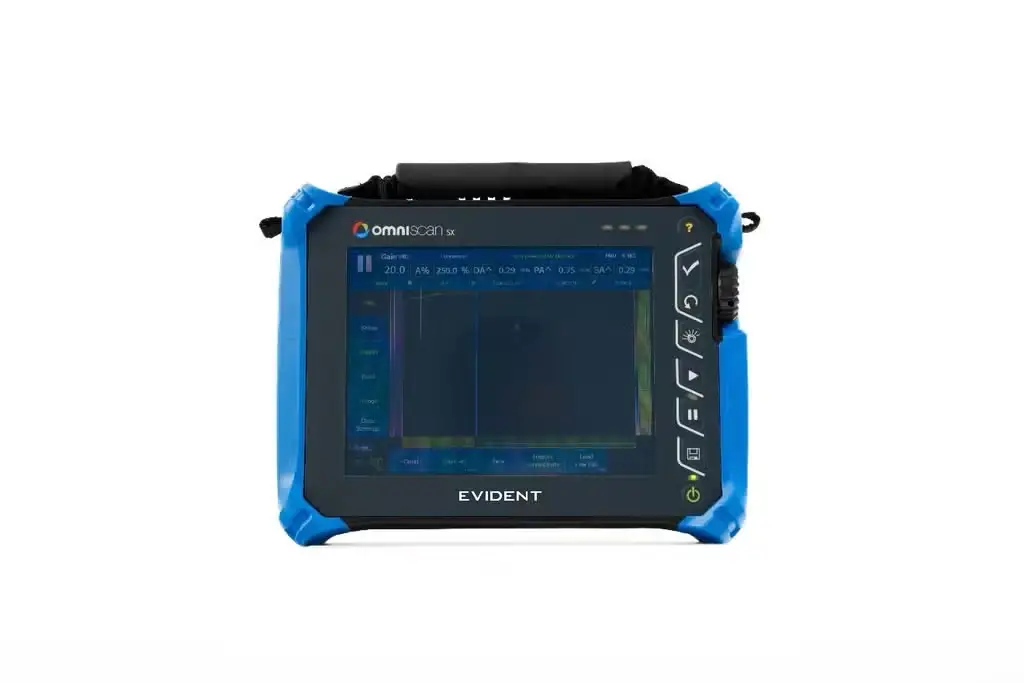
OmniScan SX
The single group, lightweight OmniScan SX flaw detector features an easy-to-read 8.4-inch (21.3 cm) touch screen and provides cost-effective solutions. The OmniScan SX comes in two models: the SX PA and SX UT. The SX PA is a 16:64PR unit, which, like the UT-only SX UT, is equipped with a conventional UT channel for P/E, P-C, or TOFD inspections.
EPOCH 650
The EPOCH 650 is a conventional ultrasonic flaw detector with excellent inspection performance and usability for a wide variety of applications. This intuitive, rugged instrument is a continuation of the popular EPOCH 600 flaw detector with additional capabilities.